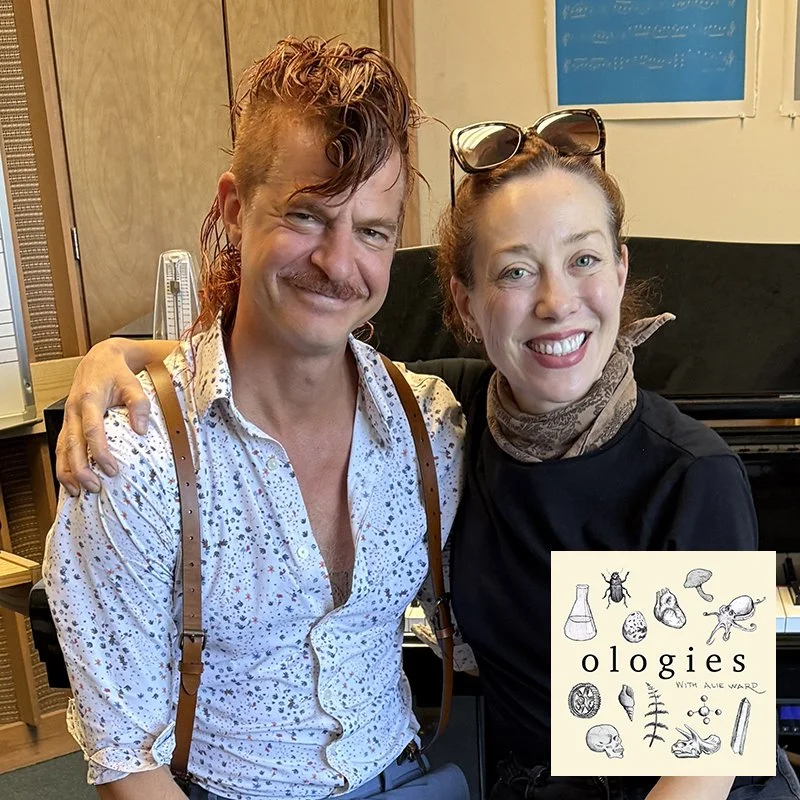
Music. Emotion. Brain waves. Whale songs. Toadfish. Distant moons. Loud apes. And why it’s worth it to practice piano. Brilliant and warm musician and assistant professor at Albuquerque's University of New Mexico, Dr. David Bashwiner is a theoretical, neuro- and Biomusicologist. Settling into his office (with a baby grand) we covered everything from bird songs to aquatic echolocation, how scales work, major vs. minor keys and their impact on the brain, music therapies, white noise, binaural beats, mole crickets, fandom as identity, spider guitar strings, Baby Mozart, so-called perfect pitch, and so much more. Stay tuned for a bonus episode hosted by Podmother Jarrett Sleeper about getting more creative musically. Go bang on something. Hard.
Listen via Apple, Spotify or wherever you listen to podcasts. Ad-free episodes available by subscribing to SiriusXM Podcasts+. Start a free trial now on Apple Podcasts or by visiting siriusxm.com/podcastsplus.
Visit Dr. Bashwiner’s website and follow him on Google Scholar
A donation went to APS International High School
Links to things we discussed:
Musical Exemplarity in the Notational Treatises of Johannes Tinctoris (c. 1435-1511)
The 5/4 Trick - How Harry Connick Jr. tricked an entire audience
Great-tailed Grackle Calling & Bathing
Midshipman Vocalizations | Ocean Conservation Research
Midbrain node for context-specific vocalisation in fish | Nature Communications
The Science Behind Acoustic Waves
Early experience shapes vocal neural coding and perception in songbirds
Developmental experience alters information coding in auditory midbrain and forebrain neurons
Why Do People Sing? Music in Human Evolution
Music as aposematic signal: predator defense strategies in early human evolution
Songs of the Humpback Whale (1970) by Roger Payne
Whale song shows language-like statistical structure
Whale songs can spread between groups nearly 8000 kilometres apart
A predicted humpback whale hearing curve based on modified behavioral observation audiometry data
Singing humpbacks are exploring, not courting, UB researcher says
Evolutionary novelties underlie sound production in baleen whales
Acoustic properties of humpback whale song
The Sonar Model for Humpback Whale Song Revised
Is Culture Dying? | The New Yorker
Can monoculture survive the algorithm?
Is This the Worst-Ever Era of American Pop Culture? - The Atlantic
Plant bioacoustics: The sound expression of stress
Review of electroencephalography signals approaches for mental stress assessment - PubMed
The impact of music on the bioelectrical oscillations of the brain - PMC
Music tempo modulates emotional states as revealed through EEG insights | Scientific Reports
(PDF) Musical Emotion: Toward a Biologically Grounded Theory
Mozart effect–Shmozart effect: A meta-analysis
How musical training affects cognitive development: rhythm, reward, and other modulating variables
Audiovisual gamma stimulation for the treatment of neurodegeneration
Evidence that gamma rhythm stimulation can treat neurological disorders is emerging
Music and spatial task performance
Tinnitus or electricity? Or both?
The Mechanism and Efficiency of Sound Production in Mole Crickets
The Tuned Singing Burrow of Mole Crickets
Absolute pitch exhibits phenotypic and genetic overlap with synesthesia
Inter-Brain Synchronization: "My fascination with the topic continues to this day!
Other episodes you may enjoy:
Molecular Neurobiology (BRAIN CHEMICALS)
Salugenology (WHY HUMANS REQUIRE HOBBIES)
Mantodeology (PRAYING MANTISES)
Misophonology (DISTRACTING SOUND & NOISE RAGE)
Attention-Deficit Neuropsychology (ADHD)
Ologies info:
400+ Ologies episodes sorted by topic
Smologies (short, classroom-safe) episodes
Transcripts and bleeped episodes
Become a patron of Ologies for as little as a buck a month
OlogiesMerch.com has hats, shirts, hoodies, totes!
Follow Ologies on Instagram and Bluesky
Follow Alie Ward on Instagram and TikTok
Editing by Mercedes Maitland of Maitland Audio Productions and Jake Chaffee
Managing Director: Susan Hale
Scheduling Producer: Noel Dilworth
Transcripts by Aveline Malek
Website by Kelly R. Dwyer
Theme song by Nick Thorburn
